15 May 2026
Establish a Branch in Belgium
Opening a branch office in Belgium offers notable advantages. Our company formation specialists are here to provide you with qualified consultancy.

Opening a branch in Belgium means that the company will be able to operate business in Belgium without having to set up a new company. In the case of the branch office, it does not exist on its own but as an extension of the parent company. This implies that all rights and obligations belong to the parent company.
| Quick Facts | |
|---|---|
| Applicable legislation (home country/foreign country) | Depending on whether or not bilateral conventions are in place between Belgium and the parent company's country of origin. |
Best Used For | The same business activities performed by the parent company. Mostly used by banks and other financial institutions. |
| Minimum share capital (YES/NO) | NO |
| Time frame for the incorporation | 2 weeks |
| Management (Local/Foreign) | Local representative to manage the Belgian branch, appointed by the parent company. |
| Legal representative required (YES/NO) | YES |
| Local bank account (YES/NO) | YES |
| Independence from the parent company | NO |
| Liability of the parent company | The parent company is fully liable for its Belgian branch. |
| Corporate tax rate | 25% |
| Possibility of hiring local staff (YES/NO) | YES |
| Naming requirement | Registered name must be the same as parent company; Branches can use a different commercial name. |
Differences from a subsidiary | – legal form, – different taxations, – liability, – incorporation process, – ownership, – financial reporting, etc. |
Special business permits | For specific industries (pharmaceutical, insurance, banking, construction, hospitability, etc.) |
| Mandatory VAT registration in Belgium (YES/NO) | YES |
| Required documents | – articles of incorporation and memorandum of the parent company, – certificate from the registry of commerce, – annual accounts, – authorized representative, – decision to open a branch, etc. |
| Documents language | Dutch, French or German |
| Virtual office option (YES/NO) | YES |
| Annual accounts | Each year the foreign parent company's annual accounts must be filed with the National Bank of Belgium (translated where required). |
| Starting commercial activities | Once it receives the registration number; The incorporation must be published in the Annex to the Belgian Official Gazette. |
| Differences from opening a company in Belgium | – legal entity, – liability, – registration process, – taxation, – management, – financial records, etc. |
| Business activities | Must be the same as in the country of origin. |
| Double taxation treaties in Belgium | 95 (approx., in force) |
| Advantages of opening a branch in Belgium | – no minimum share capital, – cost-efficient, – fast incorporation process, – parent company control, – access to Belgian and EU markets, etc. |
| Other available entities | – subsidiary, – representative office, – cooperative, – general partnership, etc. |
| Assistance | Our team can help individuals interested in establishing a branch or opening a Belgian company. |
What is the procedure of starting a branch in Belgium?
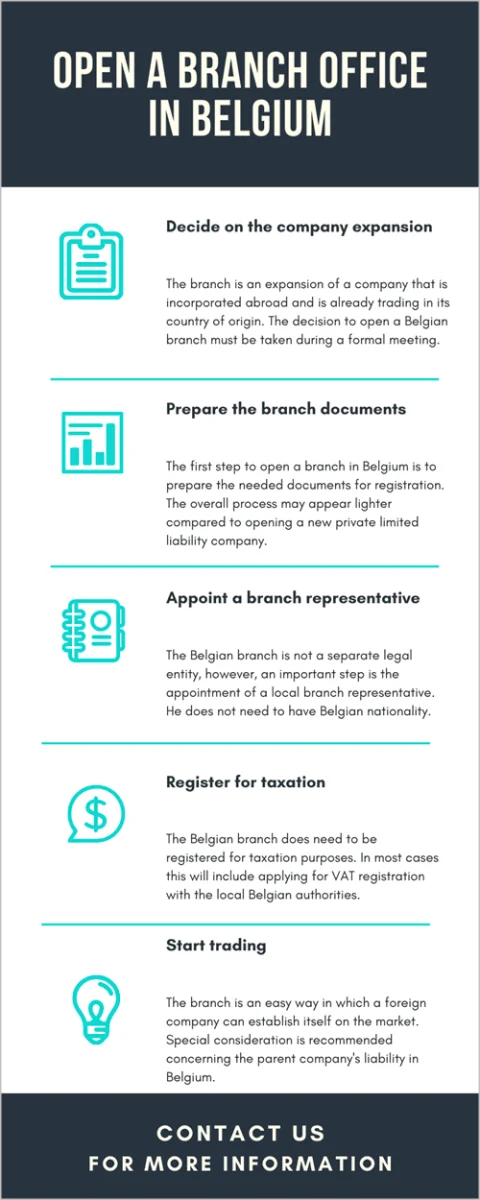
The procedure to start a branch in 2026 is not entirely the same as that required to open a company in Belgium because of the fact that the branch does not need to have its own Articles of Association. Instead:
- the foreign company will provide its own Articles, translated as needed.
- it is advisable to open a bank account in Belgium for the branch’s operations (a branch has no share capital);
- a special business permit is required for the branch in certain business sectors;
- the documents related to the branch must be drafted in one of the official languages of Belgium (Dutch, French or German) depending on the area of registration;
- the legal representative of a branch opened in Belgium doesn’t need to have Belgium’s nationality but is recommended to be based here (as all the branch’s activities take place here);
- the process of registering a branch in Belgium was simplified by introducing the one-stop-shop for companies, a centralized organism for applying for company registration, VAT, and for the specific taxes.
What is the documentation required for opening a branch in Belgium in 2026?
The following documents must be legalized by a notary from the foreign country and then translated into one of the official languages by an authorized Belgian translator:
- copy of the registration certificate;
- the articles of incorporation belonging to the parent company;
- the decision of opening a branch;
- the appointment of the representative;
- specimen signature.
The above documents must be submitted to the registry of the competent Enterprise Courtand then in the Crossroads Bank for Enterprises.
What legal formalities are applicable once the registration is complete?
Several further formalities apply to ensure compliance with the laws of Belgium after establishing a branch:
- Official announcement in the Belgian Gazette: basic data of the branch must be published, such as: the name of the parent company, its address, and its authorized representative;
- Updating of the register: if any alterations to the basic data of the parent company happen (name change, conversion into another corporate structure, changes of the registered office, etc.), they must be registered in Belgium as well;
- Use of the data in the documentations: each letter, contract, and bill that the branch prepares must contain information about the parent company and about the Belgian branch;
- Adherence to commercial legislation: the branch needs comply with the Belgian laws in terms of commerce, consumer rights, and fair competition;
- Compliance with data protection legislation: if the branch deals with personal data, GDPR standards should be met.
How to handle finance and banking for branches in Belgium?
Establishing the correct financial structure will be essential when starting a branch in Belgium, despite the fact that it will not have legal status as a distinct entity. In order to facilitate correct financial management, branches should consider:
- Opening a Belgian bank account: it is advisable since it allows handling local transactions and salaries in an effective way;
- Financial separation: it enables keeping track of the finances relating to operations conducted in Belgium separate from the rest of the world;
- Financial accounting: it should be in accordance with Belgian GAAP rather than any other standard used by the parent company;
- Filing information: some specific financial information might need to be filed to the National Bank of Belgium annually;
- Auditing needs: the branch could face some auditing needs related to the scope and the financial turnover of its activities;
- Exchange rates: despite the fact that Belgium uses euros, it is important to be mindful of possible exchange rate risks if the company conducts business in another currency.
A proper financial structure ensures easier cooperation with Belgian authorities and counterparts.
We invite you to watch the following short video on branches:

What are the advantages of opening a branch in Belgium?
The list below highlights some of the most important advantages of the branch in Belgium:
- lower incorporation costs: the costs associated with opening a branch are generally lower than in the case of the subsidiary (which can be a Belgian limited liability company);
- different annual reporting: the branch, because of its relation to the foreign company, is subject to different annual reporting requirements in Belgium; in general, these can be lighter than in the case of the limited liability company;
- control: this type of business entity is preferred in some business sectors because of the high level of control the parent company has over its branch;
- double taxation relief: branches are subject to the provisions of the double tax treaties signed between Belgium and other countries; we recommend talking to our agents specialized in company formation in Belgium for more details.
What taxes must a branch pay in Belgium?
The branch must pay the corporate tax, employment taxes, the value added tax (provided that its services or products are charged with the VAT, as per the requirements of the local law), social security and others. Some of the tax rates are:
- VAT – charged at a standard rate of 21%;
- corporate tax – 25%;
- employment taxes – they are applied based on a progressive system, meaning that lower annual income is charged with lower taxes while higher income, with higher taxes (in 2026, the employment taxes range from 25% to 50%).
For step-by-step assistance in opening a branch in Belgium,do not hesitate to contact us.